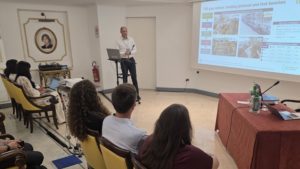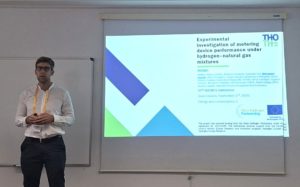
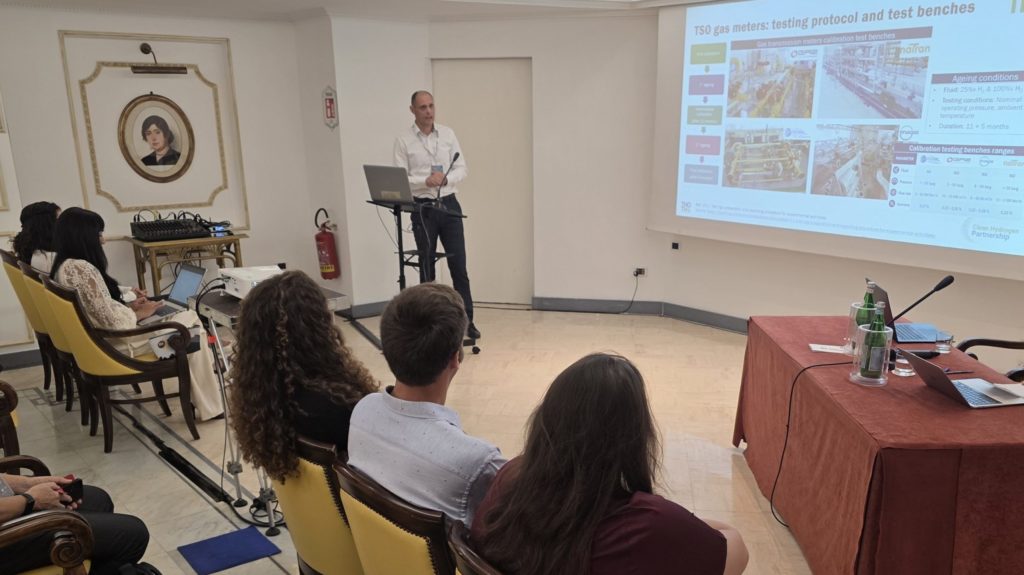
THOTH2 presented the intermediate findings from our testing campaign on metering and gas detection equipment exposed to hydrogen-natural gas (H₂-NG) mixtures. The results were presented at the European Fuel Cells and Hydrogen – Piero Lunghi Conference 2026 (EFCH₂ 2026) last September 16 in Capri, Italy.
During the conference, Pawel Kulaga, Head of the Flow Metrology Department at the Polish Oil and Gas Institute – National Research Institute presented the main conclusions obtained so far and outlined the next steps of the project. The ongoing work aims to determine whether measurement devices already deployed in gas infrastructure can continue to operate reliably as hydrogen concentrations and gas compositions change.
The testing brought together a broad range of technologies representative of both transmission and distribution networks. The transmission campaign involved 11 gas meters, covering rotary, turbine and ultrasonic technologies, while the distribution campaign comprised 11 meters, including diaphragm, thermal mass and ultrasonic devices. In addition, THOTH2 assessed 7 pressure transducers (4 resonant and 3 piezoresistive), 6 trace-water sensors (including TDLAS, ceramic metal oxide and capacitive technologies) and 5 leak detectors based on different sensing principles: semiconductor and thermal conductivity, TDLAS, catalytic, catalytic combined with infrared, and catalytic combined with electrochemical detection.
Testing conditions were adapted to the characteristics of each type of equipment. Gas meters used in both transmission and distribution networks were exposed to 25% and 100% hydrogen at their respective operating pressures. Pressure transducers were tested with the same hydrogen concentrations at 65 bar(g). For trace-water sensors, the experiments covered hydrogen and gas mixtures across different pressures and dew-point temperatures. Leak detectors, meanwhile, were assessed using a range of CH₄/H₂ compositions, from pure methane through to pure hydrogen.
The tests offered promising results, although further testing is required before drawing definitive conclusions. Longer ageing campaigns and a larger number of samples will be needed to confirm whether the trends observed so far remain consistent over time.
For gas meters, hydrogen had no significant effect on measurement performance in almost all the devices tested. The pressure transducers also showed only minor changes, with the observed variations remaining compatible with the operating conditions of current gas grids.
The results for trace-water sensors and leak detectors, however, point to a greater influence from gas composition. Trace-water sensors showed evidence of drift, highlighting the need to take hydrogen concentration into account when calibrating these devices and determining measurement uncertainty. For leak detectors, the response to hydrogen differed according to the sensing technology, with varying levels of sensitivity observed across the devices tested.
Overall, the results obtained to date indicate that a great number of established measurement technologies can deliver acceptable performance in the presence of hydrogen. At the same time, the campaign has highlighted particular devices and models that require further investigation. The next stage of THOTH2 will focus on extending the ageing tests and analysing additional samples, helping to determine whether the observations identified so far represent isolated cases or reproducible trends. This evidence will contribute to the project’s future recommendations on the use of measurement technologies in gas infrastructure transitioning towards hydrogen.