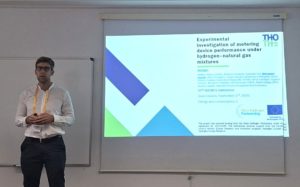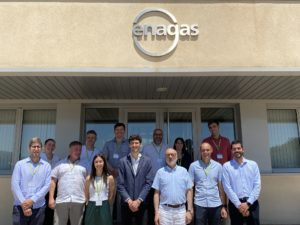
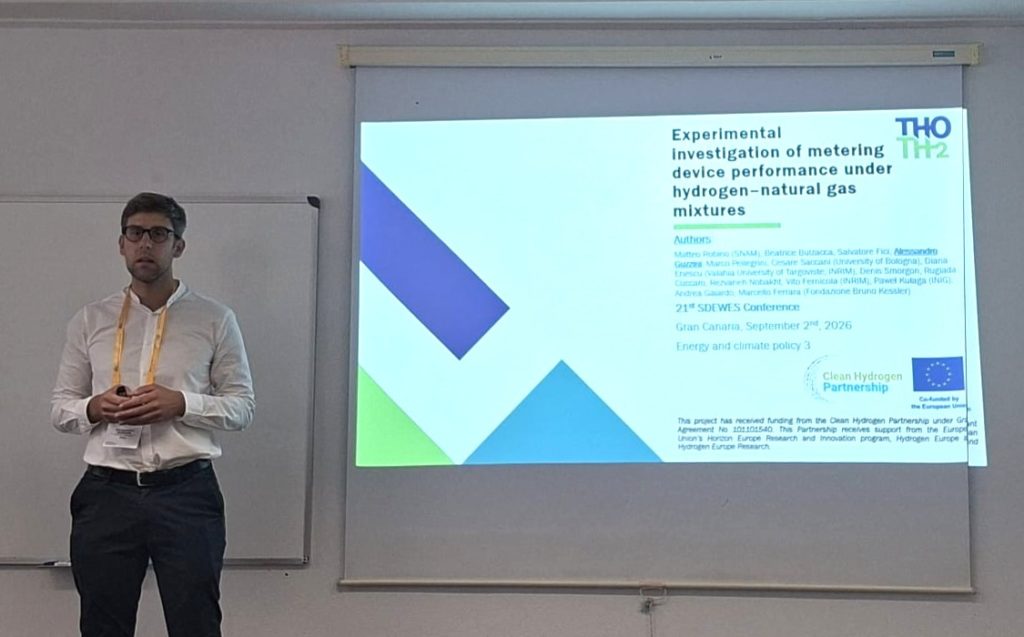
Last Wednesday, September 2nd, THOTH2 presented the intermediate results of the tests carried out on several metering devices to discover their performance under hydrogen-natural gas (H₂-NG) mixtures at the 21st Conference on Sustainable Development of Energy, Water and Environment Systems (SDEWES) that took place in Gran Canaria (Spain). Alessandro Guzzini, Research Fellow at the University of Bologna, showcased the conclusions extracted and the following steps that THOTH2 will follow to demonstrate whether metering devices installed in existing gas infrastructure can operate reliably with changing gas compositions.
The testing campaign covered several categories of equipment used across gas transmission and distribution networks. For transmission systems, the campaign included 13 gas meters (covering rotary, turbine and ultrasonic technologies). Regarding the distribution networks, 12 gas meters were selected, including diaphragm, thermal mass and ultrasonic meters. The campaign also included 7 pressure transducers (4 resonant & 3 piezoresistive models), 6 trace-water sensors (2 TDLAS, Ceramic metal oxide and Capacitive models each) and 5 leak detection sensors (1 semiconductor + TC; 1 TDLAS; 1 catalytic; 1 catalytic + IR; 1 catalytic + electrochemical).
Transmission and distribution gas meters were tested with 25% hydrogen and 100% hydrogen, under their respective operating pressure conditions. Pressure transmitters were also tested with 25% and 100% hydrogen at 65 bar(g). For trace-water sensors, the campaign explored hydrogen and gas mixtures over a range of pressures and frost-point temperatures, while leak detectors were evaluated using different CH₄/H₂ ratios, from pure methane to pure hydrogen.
The tests offered promising results, even though they need to be confirmed with longer ageing campaigns and a larger number of samples. The testing showed that the presence of hydrogen did not affect measurement performance in almost all the gas meters. In this same vein, the results from the pressure transmitters show only slight changes that are completely compatible with the current gas grids functioning.
Concerning the trace-water sensors and leak detectors. results suggest that hydrogen introduction has an effect on their performance. The trace-water sensors drift, and the gas composition needs to be considered when calibrating these sensors and assessing measurement uncertainty. On the other hand, the sensitivity of leak detectors to hydrogen varied depending on the technology used.
The results obtained so far suggest that many established measurement technologies can maintain acceptable performance in the presence of hydrogen, while also identifying specific measurement devices and models that need additional attention. The next phase will therefore be important for distinguishing isolated observations from consistent trends and for strengthening the evidence base behind future recommendations on the use of hydrogen in current gas infrastructure.