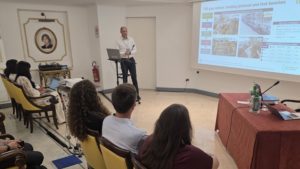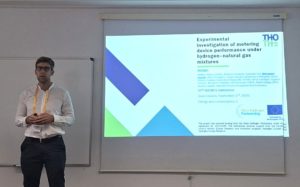
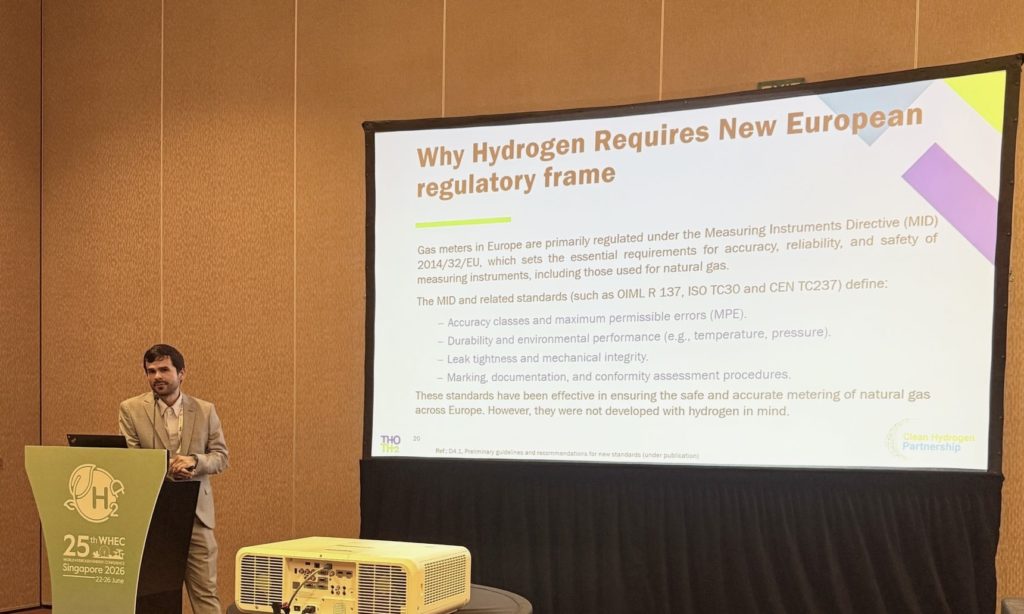
THOTH2 was presented at the 2026 World Hydrogen Energy Conference (WHEC 2026), where the project highlighted the importance of ensuring that the measurement devices currently installed in gas networks can accurately operate with hydrogen and hydrogen-natural gas (H₂NG) blends. As hydrogen becomes an increasingly important energy carrier, reliable measurement technologies will play a crucial role in enabling its safe and efficient integration into existing gas infrastructure.
During the conference, Miguel Ballesteros, Programme Delivery Manager at the European Gas Research Group (GERG), presented the work carried out within THOTH2 on the testing of measurement instruments commonly used in gas transmission and distribution networks. The presentation covered the different types of devices being evaluated—including flow meters, leak detectors, and trace water sensors—as well as the project’s testing methodology, the specialised facilities used for the experimental campaigns, and the project’s contribution to future standardisation activities. Particular attention was given to flow meters, one of the most widely deployed instruments in gas networks and a key focus of the ongoing testing programme. The complete testing campaign is expected to conclude later this year, after which the project will publish its findings.
The work carried out so far has already revealed that many of the current standards governing gas measurement technologies were developed exclusively for natural gas and do not fully address the specific properties of hydrogen. THOTH2 has identified several important gaps, including calibration procedures that cannot simply be transferred to hydrogen applications, material and sealing requirements that do not adequately prevent hydrogen permeation, durability tests that fail to consider long-term hydrogen exposure, and leak-tightness criteria that overlook hydrogen’s higher diffusivity. The project has also found that existing standards provide limited guidance on the safety and performance requirements for hydrogen sensors and gas analysers.
By identifying these challenges, THOTH2 is helping to lay the foundations for the future standardisation of hydrogen measurement technologies. The project’s recommendations aim to support manufacturers, network operators, and standardisation bodies in adapting existing measurement systems to the needs of a hydrogen-based energy system. Several publications presenting these results and recommendations are already available on the THOTH2 website, providing valuable resources for anyone interested in the future of hydrogen in Europe’s gas networks.